Thursday, December 24, 2015

Is the Pisóm C'ak'al representative of the sword of Laban and gold plates?


From time to time, I like to refer to research that points to the authenticity of the Book of Mormon. In this post, I will introduce you to corroborating evidences that I believe are key to understanding the book.

In "Mayan Glyph for Engraver/Scribe: Zoram Left His Mark" by Dr. Robert A. Pate (author of Mapping The Book Of Mormon), you can read about the relationship of the fall of the ancient Mayan civilization and the effect it had on their once meticulously recorded history. The Spaniards, in their zeal to convert the Maya, destroyed an entire library of historical documents. Precious little remains of that trove, but what does remain stands out in bold relief.

When I was in Guatemala as a missionary in 1993-1995, an Elder I knew came into possession of a copy of the Title of the Lords of Totonicapan. I saw it in his hand one day and I asked him what it was. He told me that a member of the Church there had given it to him as a gift. Thumbing through it, I was stopped in my tracks by one particular passage, written by ancient Quiché Mayans, which Dr. Pate quotes in his book:
These tribes came from the other part of the sea, from the East, from Pa-Tulan, Pa-Civan. They came from where the sun rises, descendants of Israel, of the same language and the same customs…When they rose from Pa-Tulán, Pa-Civán, the first leader was Balam-Qitse, by unanimous vote, and then the great father Nacxit gave them a present called Girón-Gagal [Pisóm C'ak'al in the book I read].
I immediately ran to the photocopy machine in the mission office and began copying every page.

Why was I so excited? You see, earlier in my mission I had bought a "Cliff's Notes" version of the Popol Vuh (Book of the Council), which is a history also written the Quiché people. I had just gotten the hang of Spanish and was curious to see if I could get through a book that was written entirely in Spanish (besides my scriptures).

This Elder had a copy of something similar and complementary to the Popol Vuh. The Title of the Lords of Totonicapan, however, had a focus on telling the straight history of wars and successions of kings and what events and totems gave them the right to rule. The word "title" in its name is to denote that it is a deed to the lands it describes in its texts.

In the Book of Mormon, we learn that the children of Lehi, when arriving in the Americas, had with them the sword of Laban (the sword of a wicked man Nephi was commanded by God to slay so he could obtain a copy of God's word preserved on brass plates), the Liahona (a sort of compass or direction-finding device or artifact), and various plates of metal (brass and gold) upon which they wrote scripture, prophecies and family records.

So that these records and artifacts could be used as a way to remind Nephi's people of their origins and their duty to God to be righteous to be preserved in the land, the commandment was given multiple times in the Book of Mormon to pass them along to subsequent generations. This "package" of items was treated as a sacred collection and was given only to those who made an oath or strict promise to protect it and pass it along as God commanded and to whom He commanded.

When I read that passage about the Pisóm C'ak'al, my mind immediately considered the possibility that the Pisóm C'ak'al was this same set of artifacts. Or, if it wasn't that exact collection, it was at least a symbolic replacement for what it used to be. The notion that a symbolic turnover of a sacred or glorious package was part of the Mayan culture indicated to me that there was at least something to study here.

FARMS (now the Maxwell Institute), published an article (PDF, 1.2 MB) entitled "Cumorah’s Cave" by Cameron J. Packer in the Journal of Book of Mormon Studies (13/1–2 (2004): 50–57, 170–71) about eyewitness accounts of what Joseph Smith, Oliver Cowdery, and other early LDS Church leaders saw at Cumorah. Several of these descriptions could be seen as fitting the specification of a "glorious package".

At the conclusion of the JBMS article, we read:
It is apparent that several of the early brethren viewed Joseph’s receiving the plates at the hill as the beginning of a war between good and evil. The unsheathed sword may therefore have been a sign that the struggle that began at Cumorah was still going on and that with the completed translation of the plates, the side of righteousness had just gained a powerful weapon in the war against evil—the Book of Mormon. It seems very fitting that the Lord, also known as the “man of war” (Exodus 15:3), would want Joseph Smith and others to know that this mortal experience is indeed a war and that He will conquer the enemies of righteousness. This may have reassured the Saints that divine help was on their side. Within the context of then-current events, namely, severe persecution of the fledgling church, the sword served as an effective teaching tool to emphasize that the Lord’s side would be victorious despite the apparent overwhelming odds against it.
This almost exactly fits the pattern in the Popol Vuh and The Title of the Lords of Totonicapan of handing down a sacred story and a sacred artifact to a subsequent generation in order to cement that generation's claim to being a holy or chosen people meant to fight to keep their inheritance.

To me, this is another concrete evidence that the stories of the Book of Mormon are based on historical fact and not upon some "fanciful tale told by a young religious charlatan" as non-Mormons and anti-Mormons have supposed.

Wednesday, December 23, 2015

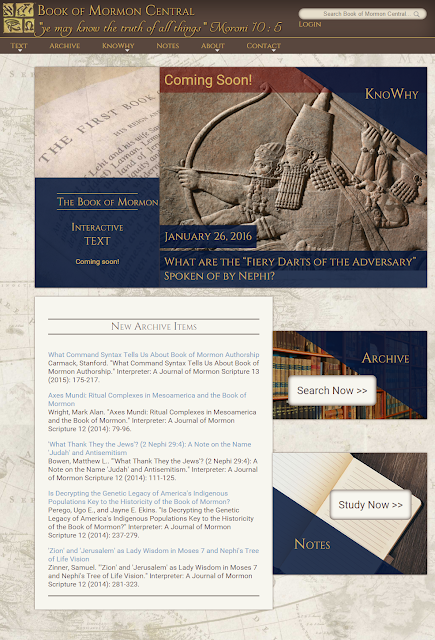
BookofMormonCentral.org soon to launch!

This is very, very exciting.

Book of Mormon Central is on the verge of publishing a new online study tool. The aim of the tool is to provide a comprehensive, one-stop shop for Book of Mormon research and scholarship.

According to the Book of Mormon apologetics blog Studio et Quoque Fide, here are the things the archive and tools are going to include:
  1. With the cooperation of other research institutions and publishers (such as Interpreter, the Religious Studies Center, BYU Studies, etc.), we are building what we hope will become a comprehensive online research archive featuring all things published on the Book of Mormon. Close to 1000 items are already in the archive, and more are being added all the time. Everything in the archive will be available for free.
  2. Using a Wiki platform, we are planning to put together Study Notes on various Book of Mormon topics. These will be encyclopedia-like entries, and the Study Notes wiki will, essentially be a free online Book of Mormon encyclopedia.
  3. An interactive online edition of the Book of Mormon text, with annotations from the Study Notes and archived materials will be available, with links back in the archive and the full Study Note entries. This will provide Book of Mormon readers with direct and instant access to the latest and most relevant information in historical, geographical, textual, cultural, theological, and linguistic analysis, as well charts, graphs, and other visuals.
  4. To help all of the great research on the Book of Mormon circulate more widely, we plan to frequently publish short, popular 1–3 page summaries focused on one specific insight into the Book of Mormon. These will be called KnoWhys, because they will not only aim to provide something new to know, but also explain why it is significant. Ultimately, it is about knowing why the Book of Mormon deserves out time, effort, and devotion. We hope to have several of these coming out each week. These will be widely shared and promoted on social media using custom memes and videos to help further get the main point across in a simple, popular format.
Of particular interest to me is the KnoWhy section, coming in January 2016, which as of this writing seems to be a section devoted to expanding on themes of the Book of Mormon that correlate with ancient literature and biblical and Book of Mormon hermeneutics and exegesis.

And, those who have a recollection of the early days of my blog will recognize one Book of Mormon Central contributor, a certain Stephen O. Smoot! Before serving his mission, he contributed a great many erudite and well-written articles here on American Testament under a different profile. I'm glad to see that he's part of Book of Mormon Central, as well as many other scholarly endeavors, and I'm looking forward to quoting and linking to his articles there!

BookofMormonCentral.org Home Page
BookofMormonCentral.org

Tuesday, November 10, 2015

Scientists Expand Archaeology Via Satellites

From time to time, I see arguments against the Book of Mormon that go something like this: 

"Scientists and archaeologists already know everything there is to know about ancient cultures and have excavated everything. There is no possibility of anything corroborating the Book of Mormon's claims." 

That is a gross over-generalization, but I don't have the time or patience to re-create them all.

Speaking of gross over-generalizations, here's proof that such statements are just that.

Archaeologists now use LiDAR, which is a remote
sensing technology that measures distance
by illuminating a target with a laser
and analyzing the reflected light.

Pioneer in Satellite Archaeology Wins Million-Dollar Prize 

"With each new batch of images, it becomes increasingly clear that archaeologists have vastly underestimated the size and scale of past human settlements. “What we’re finding is that everywhere you look there are sites,” says Parcak. “Massive sites are turning out to be many times bigger and more complex than we ever imagined.” Parcak estimates that less than 1 percent of ancient Egypt has been discovered and excavated."
Another hole in this over-generalization is that it ignores the effects of looting, not only in our time but over the centuries that preceded us. Who knows how many precious evidences of Israelites in America and the remnants of scattered tribes elsewhere have been stolen, destroyed, or redistributed out of their historical context so that we'll never know where they came from? The article talks about this as well.
"Satellite images have also revealed the accelerating scale of looting at sites around the world—particularly in Egypt, where civil order broke down during the revolution in 2011. According to Parcak, images made from space can be used to track the destruction of archeological sites and could be part of a coordinated effort to reverse the tide of looting and illegal antiquities trafficking."
But, satellite images won't be enough.
"Of course any discoveries made by these high-flying cameras will still need to be confirmed by archeologists working on the ground with trowels and sifting screens. The notion that there will always be a place for old-fashioned digging and discovery is one that Parcak finds comforting."
Book of Mormon naysayers lack imagination and initiative. They like to point at the library or university and say "those guys said they have the answers, so I don't need to know anything else". People like Parcak are the complete opposite of that, and thank goodness God has placed them on Earth.
“After teaching and working in the lab most of the year, I really need to get out in the field,” she says. “If my dirt-to-blood ratio gets below a certain threshold, I go completely bonkers.”

Tuesday, August 18, 2015

The possible science behind lighting Jaredite barges

A common critique leveled at the Book of Mormon has to do with the story of the Jaredites and their migration to the New World. In particular, the claim is made that the Jaredites (whom critics presume to be just a few years past the stone age) lighting their barges with glowing stones is scientifically ridiculous.

What I love about studying Book of Mormon apologetics is that, without fail, new evidence comes to light regularly to "confound the wise".

See "The Bologna Stone Was A Mystery For 400 Years".


"Copper ions, denuded of two electrons each, were sprinkled through the baryte. When exposed to light, they would absorb energy, and then slowly emit it over multiple days." (emphasis added)

If you've read the Jaredite account, you know that the Lord asked the Brother of Jared to come up with his own solution to the barge lighting problem. It is entirely possible that the Jaredites were technologically advanced enough to know how to make a similar material. The process is repeatable.

Friday, October 31, 2014

2,000 Year Old Tunnel in Mexico Reveals Startling New Finds


This article, Incredible New Artifacts Found In 2,000-Year-Old Mexican Tunnel, came across my Facebook timeline. Since I haven't written here in a while, I thought I'd share.

Here's one quote that caught my eye:
The archaeologists suspect it could be a tomb of the city's elite. It's there where the rules acquired divine endowment allowing them to rule on the surface, say the researchers. Archaeologists have yet to find any remains belonging to Teotihuacan's rulers.
Not that the LDS endowment would be the exact analogy to what researchers might find in this tunnel, but the form and motif aspect is very interesting.

And from the comments:
So many artifacts and pieces hinting at this complex huge society. There was a lot more going on in Mexico thousands of years ago than people realize.
I'm so glad to see that the public, and the scientific world, is finally shaking loose the shackles of ethnocentric thinking. They are beginning to realize that many, many things previously thought "impossible" for Mesoamericans anciently are now seen as more likely than not. Complex societies that built complex things and had complex lifestyles and beliefs and tools and so forth that we're only beginning to discover and understand? Check.


But we've been saying that since at least 1830. ;)

Monday, September 8, 2014

Pssst. Want to see some golden plates?

Here are three. No, they're not THE Golden Plates, but they're as close to their description as has ever been found.


They're called the Pyrgi Tablets and were found in Italy in 1964. Written in Etruscan and Phonecian, these plates are very similar in size, description, and script to the ones Joseph Smith translated. They are thought to date from around 500 B.C., which is only about 100 years later than when Lehi left Jerusalem for the Americas carrying records engraved similarly on brass plates. The gold plates from which came the Book of Mormon weren't created until after Lehi's arrival in the Americas, but it's rather safe to assume that Book of Mormon gold plates were quite similar to these.


It's fascinating to compare the form and makeup of the characters on these plates with the ones copied to paper and shown to by Martin Harris Professor Charles Anthon at Columbia University. There are many similarities. One could be persuaded that perhaps Phonecian and Etruscan were related to or even a form of the Reformed Egyptian found on the gold plates.

See also: Golden Plates by William Hamblin

Friday, January 10, 2014

Book of Mormon Challenges: Elephants in America?

Could it be there were elephants in ancient America?


Key quote from the article:
While the jury is still out, there are a number of North American Indian traditions which recount legends of giant stiff-legged beasts which would never lie down, had a big head and large leaf-like ears, round footprints, forward-bending knees, and had a fifth appendage coming out of its head.

Thursday, January 9, 2014

Book of Mormon Challenges: Pre-Columbian horses?

What about "horses" mentioned in the Book of Mormon?


Key quote from the article:
There are at least two possible resolutions to the “horse” problem in the Book of Mormon: (1) definitions were expanded to include new meanings and (2) horses were present but their remains have not been found.

Wednesday, January 8, 2014

Book of Mormon Challenges: Why anachronisms?

Why are there anachronisms in the Book of Mormon?


Key quote from the article:
The Book of Mormon has frequently been charged with containing numerous anachronistic items including certain animals, plants, metals, textiles, and weapons. In all instances, however, there is the possibility that (a) such things were once in the Americas but the evidence has either disappeared or has not yet been found, or (b) Book of Mormon labels are based on the re-labeling of New World items with familiar Old World labels. To claim that things did not exist because they have not been found is to commit the logical fallacy of arguing from ignorance or silence. According to a famous and generally accepted archaeological dictum, the absence of evidence is not evidence of absence.

Book of Mormon Challenges: Taken from other manuscripts?

From Book of Mormon 1: Taken from other manuscripts?


Key quote from the article:
Even many years later, after Rigdon had apostatized from the Church, he denied ever having seen the Book of Mormon until it was introduced to him by the Mormon missionary Parley P. Pratt. Somehow the Spalding manuscript was lost and then resurfaced in 1884 in a pile of papers belonging to a man who had bought Howe’s business. Examining Spalding’s actual novel proved that the Mormons had been right all along; any similarities between the manuscript and the Book of Mormon were superficial.