Showing posts with label Nephite. Show all posts

Friday, November 11, 2011

Criticisms and Responses: The Hill Cumorah's Location

There are various primary criticisms that tend to be hurled at the Book of Mormon, but which have been addressed many times. One need only use Google to dredge them up, but similarly, Google can be used to find the counter-arguments. More people ought to do the latter when they see the former. This series of posts represents my responses to those criticisms.   


Criticism: If the evidence points to Mesoamerica as the location of Book of Mormon history, then the final battle at the Hill Cumorah couldn't have happened in the state of New York. It's too far away!

Response: That one, in retrospect, has baffled some LDS folks as well. When the theory of pan-American Nephite and Lamanite societies persisted, it made perfect sense that the battle and where Moroni buried the plates were one and the same. One thing that didn't make sense was the the manner in which Moroni had wandered after the Nephite genocide. He was a Nephite and the Lamanites killed every Nephite they saw, so he naturally had to "get outta Dodge" indefinitely. Why, then, would he risk a) returning to the battle site and being killed before even having a chance to bury the plates and b) having the plates discovered and destroyed by Lamanites (who, the Book of Mormon states, had a keen interest in erasing Nephite claims to their territories, and thus the very records from Nephite history, just as pharaohs did to each other in Egypt).

That pan-American theory wasn't held by everyone, though. We do have an editorial in the Times and Seasons, from the pen of Joseph Smith:
Central America, or Guatimala [the whole of what we now call Central America was then known as Guatemala], is situated north of the Isthmus of Darien [Panama] and once embraced several hundred miles of territory from north to south. The city of Zarahemla, burnt at the crucifixion of the Savior, and rebuilt afterwards, stood upon this land.
When the Mesoamerican model was proposed by Mormon scholars in the latter half of the 20th century, it started to make more sense. One very strong clue is that there are multiple descriptions in the Book of Mormon of travels between areas near the battlefield hill Cumorah (a.k.a. Ramah) that are decidedly Mesoamerican in context and do not support a 3,000 mile detour north to present-day New York and back. Rather, those on-foot journeys happen in a matter of a few days.

So, it seems more likely that Moroni really "got outta Dodge" by going so far north, and that is consistent with his own description of having to wander "whithersoever I can for the safety of mine own life" because the Lamanites "put to death every Nephite that will not deny the Christ". It also makes sense in terms of God seeing far enough ahead to know that the plates would lay completely undiscovered and undisturbed in an area so relatively sparsely populated for so long until Europeans began to homestead there.

Another clue, when you read more closely, is that Moroni never actually claims to have returned to the battle site, nor does he claim to be burying the final plates in a hill called Cumorah. He just says he's "sealing up these records" (Moroni 10:2). However, Moroni's father, Mormon, does hide his set of plates and other records in the hill Cumorah near the battlefield Cumorah (Mormon 6:6). Because Mormon, before he dies, says he hid all the records "save it were these few plates which I gave unto my son Moroni", there is no evidence to suggest that Moroni's set of final plates, the ones he would turn over to Joseph over 1400 years later were hid in the same hill. Those are all interpretations that were overlaid on that narrative by those of us reading it in _our_ day.  We members of the LDS Church and other commentators gave the name "Cumorah" to the hill where Joseph found the plates under our own assumption that it was the very same Cumorah, near the battlefield, in which Mormon had hid his records. Moroni never wrote that his own hiding place was called "Cumorah", nor claimed to have buried it in the same place as the battle.

This, of course, is a common misunderstanding about the book by "Witnessers". Newcomers to the Book of Mormon (especially those who've never actually read it) can't be blamed for repeating it since it is difficult sometimes, even for faithful and knowlegable members of the church, to separate LDS lore from what our texts actually say. And it all fits perfectly with Hugh Nibley's pointed analysis and observation that people love to attack the Book of Mormon by first attributing to it something that it does not actually say, then attacking those points.

For more extensive commentary and analysis on the Cumorah subject, see

Friday, November 4, 2011

Criticisms and Responses: Bible vs. Book of Mormon Archeaology

There are various primary criticisms that tend to be hurled at the Book of Mormon, but which have been addressed many times. One need only use Google to dredge them up, but similarly, Google can be used to find the counter-arguments. More people ought to do the latter when they see the former. This series of posts represents my responses to those criticisms.

Criticism: The Bible is archaeologically verifiable, so that means it's true without question. The Book of Mormon isn't archaeologically verifiable, so that means it's false.

Response: Read The Book of Mormon, The Doctrine and Covenants, and the Archaeology Question which illustrates and summarizes the fallacy of archaeological verification = theological verification arguments. The first comment at the end is a good one as well as the huge number of archaeology and evidence-of-authenticity articles linked in the footnotes.

Neither the Bible or the Book of Mormon have ever claimed to be primarily texts that can be physically verifiable by physical evidences. Both have the cause of converting people to the Gospel, not proving or disproving this or that archeaological or anthropological theory.

The fact that historical places of the Bible have been more adequately preserved while the Book of Mormon's have not is not evidence that the Book of Mormon is false. Lots of civilizations and their records have been lost to history. I'm sure there are plenty of subcultures in, say, Mongolia or China or Indonesia that we'll never know about because of the tendency of time and human activity to erase those evidences.

Central America is quite well regarded by archaeologists as a place where evidence of past civilizations is in rapid decay because of three factors: 1) climate (jungle rot being a key result), 2) foliage (huge trees with enormous root systems that overtake and pulverize mounds of rock placed by humans), and 3) human activity (later cultures overtaking and erasing the history of earlier cultures).

Here are some well-known examples of these three factors:
  1. Anything carbon-based or organic (i.e. that isn't rock) will either disintegrate in a few months to a few years, or it will grow. With the exception of gold, this is true of metal as well. Iron or copper implements will simply cease to exist in a couple hundred years due to high humidity, heavy rain, and acidic soils. The iron and copper weapons that were preserved in Mesoamerica were the extreme exceptions or were found in more arid areas.
  2. Guatemalans erect high fences by simply cutting the limb off of a tree, sticking the newly cut ends of the limbs into the highly fertile ground, and then waiting a year. That's how quickly foliage can grow there. Huge rainforest trees have massive root systems that hold the soil together, but also displace any solid objects in their path of growth.
  3. Pyramids built by earlier Mayan and pre-Mayan inhabitants were "repurposed" and built upon to create ever larger pyramids. In fact, a very familiar sounding name is given to some ruins in Belize that features this "stacking". The name the city's ancient inhabitants gave it was Lamanai (Lam'an'ain), which is identical to the Hebrew pronunciation for Laman (minus the suffix). We have only uncovered a few of these but there are many more out there we've not yet explored. In each one we've explored, we've been astonished at the amount of knowledge about preveious cultures through inscriptions and other evidences hidden in the layers.
I have personally witnessed the effects all three of the above phenomena. I saw #2 and #3 in the then-recently discovered Abaj Takalik dig near Coatepeque, Guatemala. In terms of uncovered ruins, I've personally seen dozens of pyramid-shaped mounds, and hiked on a few, that were completely out of character with the surrounding landscape. They were absolutely human-made but were covered by tons of earth and vegetation all around before the trees covering them were cut down as cattle farmers took over the area in recent history.

The conditions under which the Nephites were exterminated in 420 A.D., with Lamanites spitefully and simultaneously erasing every part of Nephite culture and history, then what is the likelihood that we would find a remnant of their culture nearly 1600 years later? Don't forget also that zealous Spanish missionaries destroyed all but four Mayan codices. We're lucky to have what we have about ancient Mayans and their evidences more closely align with the decline of the Lamanites after the Nephite genocide.

Friday, October 21, 2011

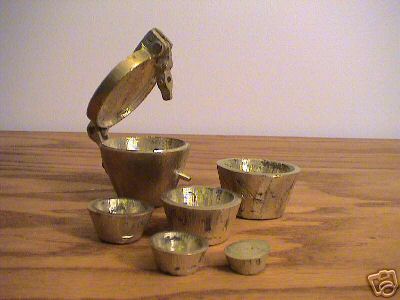
Book of Mormon Month - Day 21: Weights and Measures

Weighing and Measuring in the Worlds of the Book of Mormon


Midway through one of the most heart-wrenching accounts in the Book of Mormon, when Alma and Amulek were on trial for their lives and Amulek's faithful women and children were put to death by fire, the story is interrupted with an explanation of King Mosiah's system of weights and measures (see Alma 11:3–19). It is a strange interruption, a mundane hiatus, but at least a relieving diversion as the tension mounts in Alma and Amulek's showdown with Zeezrom and the legal officials in Ammonihah. Why would one bring up these incidental economic nuts and bolts at such a point in the record?

Several reasons might explain why this information was included at this point in the Book of Mormon. For one thing, these short metrological details are not only intertwined with the debate between Amulek and Zeezrom (see Alma 11:21–25), but they alsoprovide an important building block in Mormon's grand narrative. By abusing the justice system and misusing the lawful weights and measures, the wicked people of Ammonihah effectively opened the floodgates of God's judgment upon themselves, a pattern that would apply later to Nephite civilization as a whole.

Read More

Sunday, May 23, 2010

Is the Book of Mormon really "chloroform in print"?

Grant Hardy at Slate.com explores the notion attributed to the Book of Mormon by Mark Twain that the Book of Mormon is boring and has no inherent redeeming value as literature or scripture.

I have to admit that, at one point in my teenage years, I agreed with Twain, even if it was mostly in jest, that the Book of Mormon was indeed "chloroform in print". There were many BoM reading challenges in Seminary classes which I found myself dozing off both in class and at home. It was only the gentle prodding and great teaching of my Seminary instructors that kept my interest buoyed.

It was when I became a missionary that I really got serious about digging into the book and its chronology as it related to its core message. I had a testimony of it because of genuinely applying its teachings in my life and praying to know of its truth, but I was missing that "page-by-page" understanding of its sequence. I couldn't quickly turn to a particular story or random page and tell anyone its context and significance as part of the whole book.

Having done that, I can tell you that the Book of Mormon is definitely NOT "chloroform in print". Mark Twain's statement transparently reveals the lack of seriousness and depth with which he explored its pages.

As a parent, I can tell you that I'm grateful to have made more effort than Twain or others who attack the book based only on a cursory or partial reading.

Daily I can turn to a story or example in teaching my kids how to get along with each other. First and Second Nephi are ALL about family ties and the behaviors and consequences of family living, especially within the context of God's will for families.

The Book of Jacob helps me shield myself from the soul-cankering influences of pornography and immorality that surrounds me. Jacob 5 teaches me the causes behind the wars and conflicts in the Middle East and elsewhere and the interfaith bickering that happens in our world.

The Book of Enos teaches me how to pray.

The Book of Mosiah helps me understand how a country should be governed, how to treat my fellow men, why the Savior performed the Atonement, and the fact that no matter how small a concern even a portion of a nation is in the context of the world's way of seeing things, God will still send a prophet to warn it of danger and to organize His Church there.

The Book of Alma is rich in just about everything there is to experience in life:
  • distinguishing between truth and error
  • avoiding bringing negative consequences upon oneself through rebellion against God
  • how to share the Gospel with others in a way in which they will most likely respond positively
  • on which criteria mankind will be judged
  • why bad things happen to good people
  • why good things happen to good people
  • why good things happen to bad people
  • the beauty of suddenly having religious freedom when none existed prior
  • the horror of losing religious freedom when once enjoyed
  • why repentance is necessary, and how to do it
  • why the philosophies of the world are bankrupt and without foundation
  • what the purpose of the Law of Moses was (to point to Christ)
  • why bridling your passions is a Godly thing to do
  • who are we
  • why are we here
  • what happens after we die
  • how it's possible to fight a war in a way that God finds acceptable (not appealing, just acceptable in the event that no other option is available)
  • why kings are always problematic in the governance of a nation
  • why division and contention is always problematic in the preservation of freedom
The Book of Helaman teaches us why we must always be careful never to let "secret combinations" or conspiracies, mafias, gangs, government cabals, terrorist groups, etc. become the order of society.

Third Nephi teaches us that Jesus had love for other children not of Jerusalem's fold and that His Gospel doesn't change whether taught in Jerusalem, in Zarahemla of the Americas, or in any other nation. Most importantly, it provides the key second witness that Jesus is the Christ, the resurrected Savior of the world, in every literal sense and reality.

Fourth Nephi, even though only one chapter in length and spanning a period of over 200 years, is most instructive in its preservation of a record of what causes years of peace...and what ends that peace.

The Book of Mormon (meaning, the subsection of the whole book by that name) gives us a thorough rundown of everything we are about to experience as our own world crumbles and decays in a "horrible scene of the blood and carnage" like the sequences of events the prophet Mormon experienced. This is a book to pay attention to if you want to know what we're in for.

The Book of Ether is a microhistory that parallels the history of the Nephites and, again, emphasizes the irreversible nature of mutual genocide and fratricide that emerges from secret conspiracies to "get gain" and obtain the temporary kingdoms of the world.

Finally, the Book of Moroni, in all its brevity, gives us pearls of great price such as the proper manner of baptism, of the sacrament supper of the Lord, of the order and organization of the Lord's Church, and of the necessity of faith in a world of unbelief. Moroni teaches us that if we fail to see miracles in our day, it is through our own lack of faith and not because there are no such things as miracles. If we have gotten to that point, then we are ripe for destruction, just as his own people had become. Faith precedes the miracle.

So, if you had previously been in agreement with Mark Twain about the Book of Mormon being impossible to get anything out of...or if you believe that there is no literary redemption in the Book of Mormon...consider what I have outlined above and ask yourself if any of those items could be useful to you. There's bound to be at least one. Pick that out from the list and resolve to explore how the Book of Mormon expounds on it.

You'll be surprised at how truly interesting the Book of Mormon actually is.